
One God Going Mad
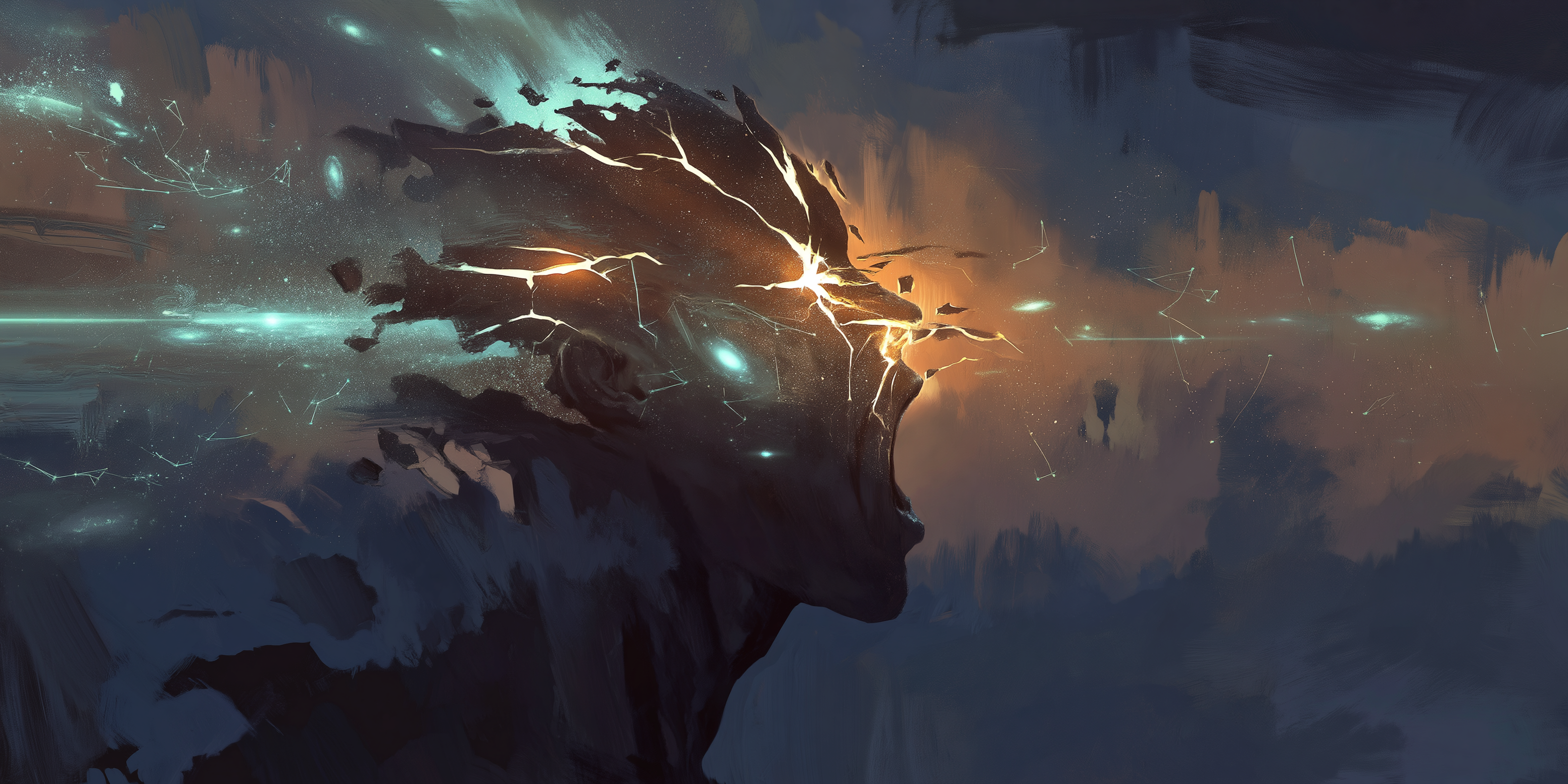
I've been sitting with a question for a few weeks now. What if every god, across every pantheon, every echo of spirit worship and ancestor veneration, every ideal given a name and a prayer, was a splinter personality of a single creator going slowly insane?
This post is the first in a series called Worlds, where I walk through the actual process of building a setting from scratch. Not the polished wiki version. The messy, exploratory version, where half the ideas are wrong and the good ones haven't proven themselves yet. I want to show what it looks like to take a single idea and chase it until it becomes a place.
Before anything else, the ritual
Every world I build starts the same way. I make a playlist.
This isn't productivity advice. It's more like setting the temperature for the work. The music tells me what kind of world wants to exist before I've figured out a single detail. I never used to do this, but as I have gotten older, and learned a bit more about my ADHD brain, I've learned how easy it is to manipulate it into different thinking states. Cool (and terrifying, but that is another blog post for another time). For this one, I went straight to trip-hop and dark instrumentals. Massive Attack and Portishead. Vallis Alps, which has a lighter tone. The kind of music that feels like driving through fog at 2 AM, where everything is half-visible and you're not entirely sure where the road goes.
A story or a world should arrive rather than be engineered.
This put me in a headspace where I'm not trying to solve anything. I'm just following threads. Le Guin talked about this kind of process, about letting a story or a world arrive rather than engineering it. I don't always manage that patience, but the playlist helps; and, as an engineer this requires a bit of extra discipline, but is also so deeply rewarding.
The mood I landed on: something heavy and slow-burning. A world where the beauty is real but the foundation underneath it is cracking. That became the north star for everything that followed. (Ok, so, maybe I technically did engineer something).
Principles, not rules
I find myself drawn to stories and worlds that have depth, that feel lived in. I love when someone takes an established world and looks at it sideways. Take Andor, and Rogue One before it. So much of what makes Star Wars what it is centers on the Force. A mystical battle between Jedi and Sith. But Andor was lived-in, gritty. A spy and political thriller that happens to be set in the Star Wars universe. Ideological conflicts that can exist regardless of the scenery.
I didn't want to box myself in, but I wanted guardrails, something to keep the vision honest. So I thought about what I loved from games I'd played and media I'd consumed.
Finding the world through curiosity
I just kept following the questions.
Do the gods know? My instinct said no. Most of them don't. They believe they're sovereign, independent, eternal. They have their own followers, their own domains, their own rivalries. They wage wars against each other without realizing they're fighting themselves.
But what about the ones who do know, or suspect? What happens to a splinter personality that becomes aware it isn't whole?
Those gods, the aware ones, would be the ones every other pantheon calls mad. The chaos gods. The tricksters. The ones whose behavior seems erratic from the outside. But from the inside, they're the only ones seeing the full picture, and the full picture is unbearable. I think there's something genuinely tragic there, and tragedy is exactly the kind of emotional territory I wanted this world to live in.
This is a pattern I come back to constantly: find the mess. Sanderson talks about this in his lectures, not the magic system stuff everyone quotes, but his point about tension and cost. Stories are most interesting where things are broken, where power fails, where the clean answer doesn't exist. The same is true for worlds. If I'm building a pantheon and everything is orderly and well-defined, I haven't found an interesting story. The world may be cool, but not captivating.
The same fable, told by different splinters
If all these gods are fragments of one mind, then the mythologies they inspire wouldn't just be similar. They'd be echoes. The same fables showing up in different religious texts across the world, sometimes highlighting different parts, sometimes omitting details the other version includes.
From the outside, scholars in this world would debate whether it's cultural diffusion or shared archetypes. The Rashomon effect at civilizational scale, every account true, every account incomplete. But the real answer is stranger: these aren't parallel stories about similar events. They're the same memory, fractured across multiple personalities, each splinter remembering the parts that belong to them and forgetting the rest.
This is something I borrowed from how unreliable narration works in film. Rashomon is the obvious touchstone, but I also kept thinking about how Dark Souls handles lore. In those games, you piece together history from item descriptions and environmental details, and the picture never fully resolves. There are contradictions - those contradictions don't make the world less believable, they make it more. The world is decaying, and the history is decaying with it. I wanted that same feeling here, where the more you learn, the less certain you become.
Fractures in the landscape
If reality is sourced from a mind that's cracking, what does that look like physically?
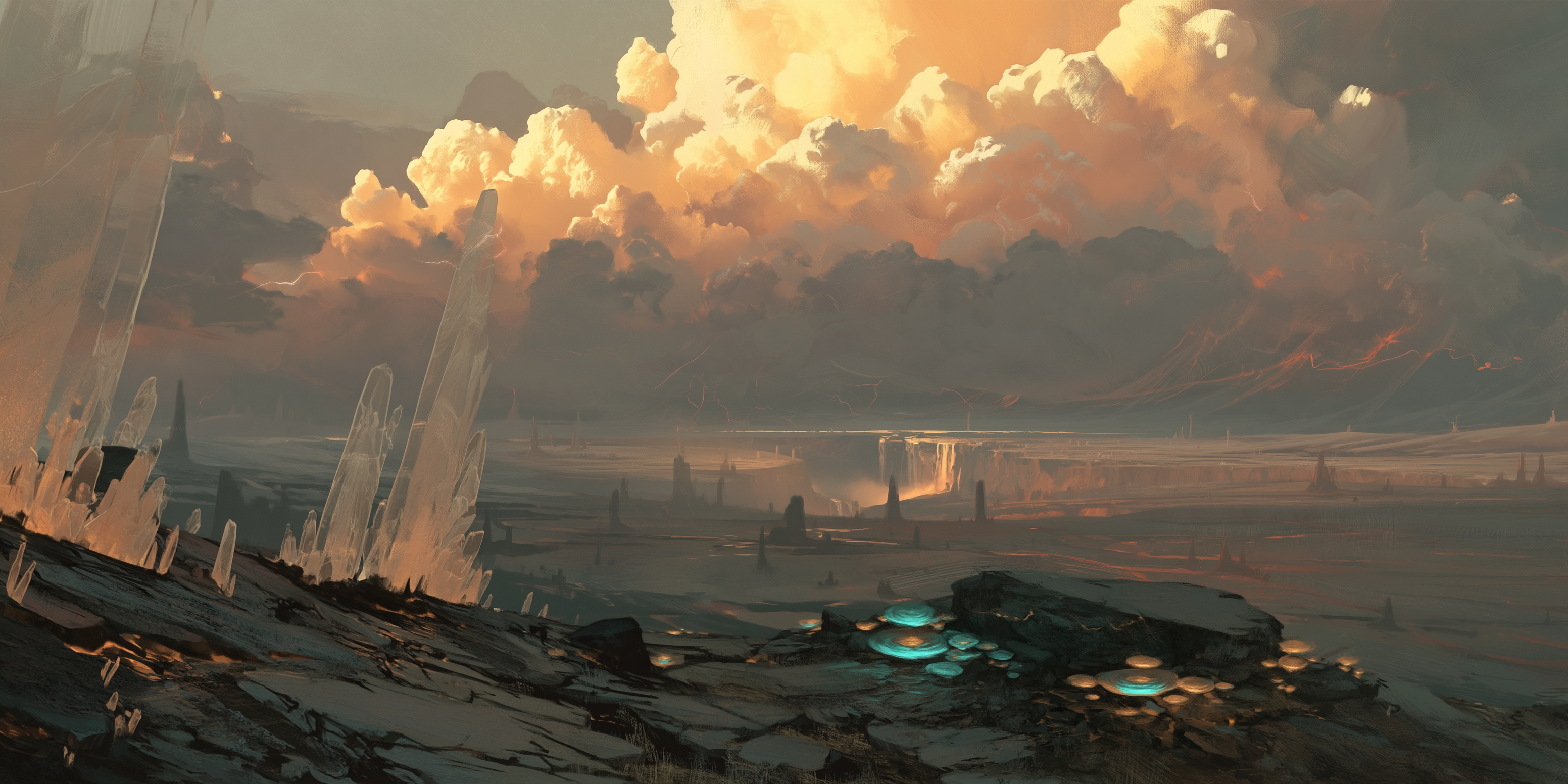
I started imagining arcane fault lines. Boundary zones where the fabric of the world is thin, unstable, or actively tearing. Places of immense beauty and immense danger. Where the rules are unreliable. Where landscape and weather and even time behave strangely. Think of them as the visible symptoms of the creator's deteriorating psyche. But like fault lines, this isn't a curtain or a persistent thing. The time scales are entirely different. This is a chaotic biome, with creatures and people adapted to it. If we can track earthquakes along tectonic plates, predict monsoon seasons, map the rhythms of El Nino — why wouldn't the people of this world learn to read their own reality-shaping storms the same way?
The Unmade
From the worst of these tears, something is coming through. Creatures that don't belong to the world's logic. They aren't evil in a motivated sense. They're just wrong, the way a tumor is wrong. They exist because something that shouldn't be open is open.
When I'm building a world rich with conflicts — political, religious, territorial — it becomes important to find the uniting forces. The Unmade help provide that. A threat so alien and so indifferent that it gives fractured cultures common ground, even if they can't agree on anything else.
The people the world shapes
Ancestries are pillars in most fantasy, and the notion that they are aspects or images of one god or another is far from new. But what happens if the ancestries were the first signs of the early psychosis, vain creations of a splintering mind? And what if, over countless generations, those ancestries mixed the way populations do in the real world? What if "humans" are just the average — a collective blending of all the others? Would there even be "real" elves or dwarves anymore, or just degrees of heritage? Are there ancestries that can't procreate with each other? Why?
These are origin questions. But the landscape shapes what comes after. If the world was populated before the gods, are there any cultural or generational memories of that time? How long has this been going on? What was it like for these people to experience the "birth" of entire pantheons? Or did they not realize it? Was the creation of a god something so powerful that evidence and memory of a time before vanished like it never existed?
These boundary zones also create natural isolation. Communities separated by zones they can't reliably cross, or at least not without preparation and resources. Cultures that develop in parallel with infrequent contact. The world's own instability creates the map.
What about the cultures that live inside the boundary zones? That question excited me more than almost anything else. What kind of society forms in a place where the rules keep changing? Where the land itself can't be trusted? I'm leaning towards a nomadic culture - something deeply rooted in fate and prophecy and portents. Distributed, mobile, malleable.
And then there are the larger regions, those whose boundaries are distant, with a degree of safety and disconnection. Maybe complacency and gluttony at the seat of power. But their borders are vast and dangerous, and these factors shape the culture, the beliefs, and those in power. This is another dimension to the same forces that define our own cultures: availability of resources, protection from outsiders, quality of life. How does transport and trade look? How does one prepare to cross a "pass" in the boundary zone where the climate shift is abrupt, not gradual? The isolation is interesting, but so is the connection.
Magic as accelerant
Every fantasy world needs to answer the magic question eventually, and I wanted to do something specific here. What if arcane magic and divine magic both sourced from the same place?
Divine magic flows through an intermediary, one of the splinter gods, filtered and shaped by that fragment's personality and domain. Arcane magic taps into the source directly. No intermediary. No filter. Raw access to the creator's fracturing mind.
Which means every spell cast by an arcanist is, in some tiny way, accelerating the creator's descent into madness. And nobody knows. The mages don't know. The gods don't know. The scholars studying the theoretical underpinnings of magical law don't know. Magic works. It's useful. It builds civilizations. And it's slowly destroying the foundation those civilizations stand on.
Magic is most interesting where it costs something. Not mana points. Real cost.
Sanderson's principle keeps showing up: magic is most interesting where it costs something. Not mana points. Real cost. In this world, the cost is existential, and it's deferred. Everyone benefits now. The bill comes later, and it comes for everything.
I didn't plan this when I started. It emerged from following the logic of the premise. If the creator is fragmenting, what makes it worse? What if the thing people rely on most is the thing doing the most damage? That's the kind of structural irony that makes a world feel alive. The Wire does this better than anything else I know, where every institution, no matter how well-intentioned, produces the opposite of what it promises.
Genre as a steering mechanism
At some point during this process, I had to name what I was building. Not the world itself, but the genre. Deciding this early can shape every choice you make, and I've built worlds where I applied that lens from the start. But for this one, I wanted to live in a vibe first. Get the early ideas down without boxing them in. Once I had enough to work with, I started reaching for genres and labels — not because they define the world, but because they carry expectations, and those expectations help frame everything that comes next.
I'm not sure I've completely landed on the right ones. But I've chosen dark fantasy, weird, and tragedy. Three words that told me more about the world than ten pages of notes would have.
The genre decision also shaped the revelation structure. At the base tier, dark fantasy gives you grounded, intimate stories — the Unmade are at the gates, the fault lines are dangerous, and the stakes are personal. At the middle tier, weird kicks in. Hints that the gods might be connected. Fables that match up in suspicious ways. Characters who learn just enough to be dangerous, and just enough to be wrong. This is the Mistborn layer, where the cosmology starts peeking through, but it's partial and possibly misunderstood.
At the top tier, tragedy. The full picture. The creator. The splinters. The fact that magic itself is the accelerant. The very thing keeping the Unmade at bay is the thing driving the creator further into madness. Stopping magic means losing the only defense. Continuing magic means accelerating the collapse. Not sad endings. Impossible choices.
I considered going with a more cosmic horror approach, but that feels a little too helpless for this world. I want that juxtaposition — hope and sadness, melancholy without dipping into despair and desperation. Those are different stories to tell, and maybe I'll go there. Or maybe more correctly, maybe the world will take me there. I'm excited to find out.