Canonry
AI worldbuilding for serious creators

Build a world that never contradicts itself.

Most worldbuilding tools give you a blank wiki and expect you to fill every page. Most AI tools fill it for you and hand you something you'd never actually run. Canonry does neither: 19 specialists interrogate the world you already have — what your history omits, who pays for your war, what your magic costs — and propose directions. You choose, you edit, you approve. Nothing enters your canon that you didn't put there.

Free, one world, no card.

The Codex of Sundara
87 leaves
Index
The Veiled Archive
/sundara/powers/the-veiled-archive
Published v4
Lady Maren Solmarch
/sundara/figures/lady-maren-solmarch
Your Historian is writing
The Sundering
/sundara/histories/the-sundering
Published v5
The Expansion Faction
/sundara/radiant-throne/the-expansion-faction
Proposed
The Tidecaller Maritime Code
/sundara/powers/tidecaller-maritime-code
Stale, review
Nothing you build is lost.Open leaf
The cost of forgetting

Every world starts consistent. Then it doesn't.

It surfaces at the worst moment: a continuity error a player catches mid-session, in front of the whole table. Or the one a reader finds in book three, undoing a promise book one made. You didn't lose the thread on purpose. Nothing was checking it against what came before.

What you walk away with

Years of canon, in an afternoon.

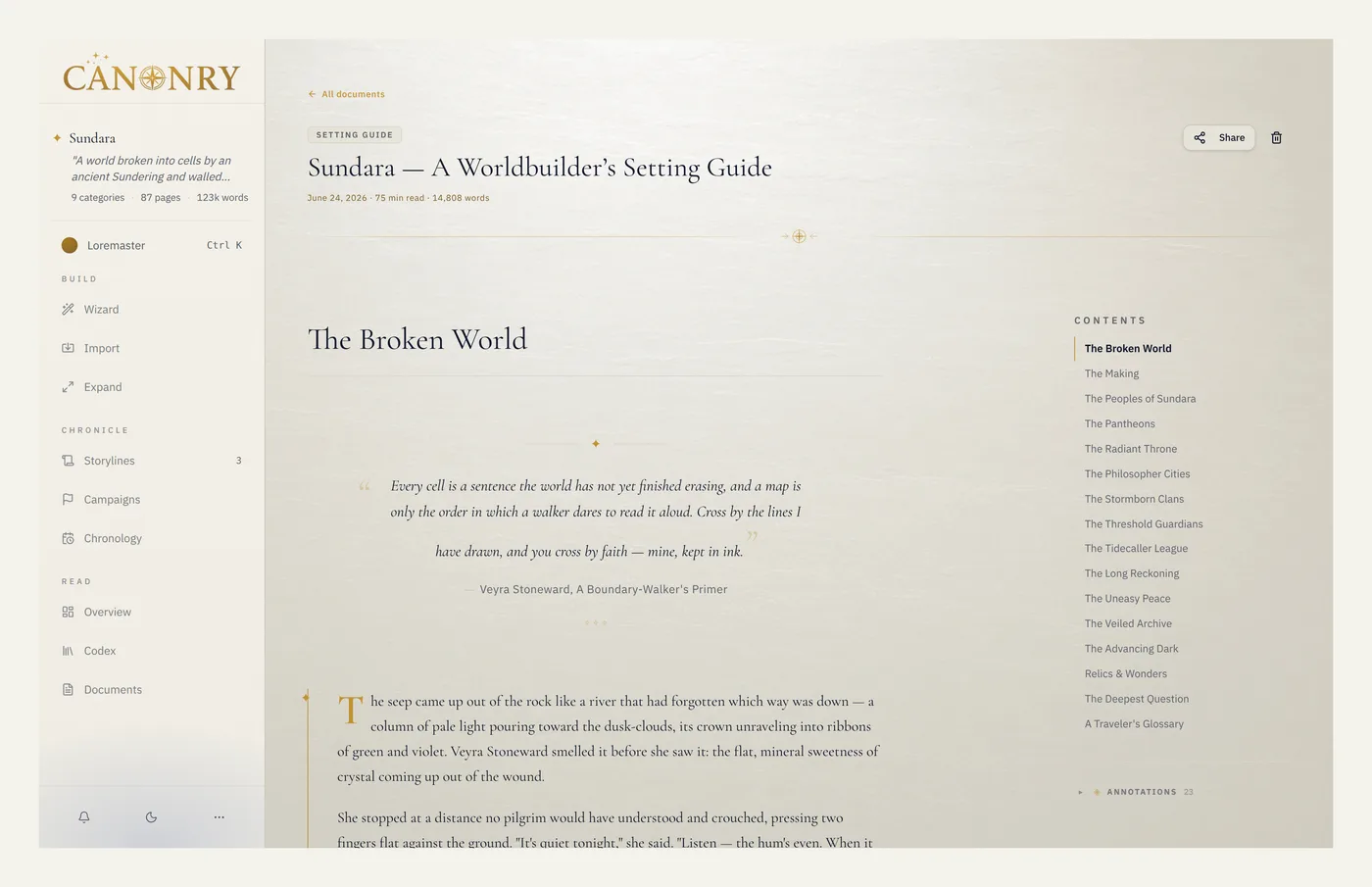
A setting guide of 12,000–48,000 words: in-world documents, scene vignettes, a voice that reads written rather than generated. Export it to Obsidian and it's yours.

sundara · a worldbuilder's setting guide
A generated Sundara setting guide open in the app, its header reading 75 min read and 14,808 words, beside a contents rail of seventeen sections
12–48kwords of literary prose in a single guide, exportable to Canonry or Obsidian.
  • Dramatic vignettes and in-world found documents, not encyclopedia stubs.
  • Canonry finds the thin spots and recommends where to deepen next.
  • A living world you return to across years, never a one-shot dump.

Game masters

Player's Guides without spoilers, DM's Guides with every secret. Keep your table in a world that stays consistent.

Authors & screen writers

The backstory your novel, series, film, or game deserves, a story bible in a voice that reads like discovered lore, not exposition.

Game designers

Setting Guides for your homebrew systems. Every detail consistent, every fact traceable, every culture coherent.

Free, one world, no card. See every plan.

How it works

Nineteen specialists ask the questions you haven't.

You answer; they build the consequences. They never write your world for you — that is the entire design.

01

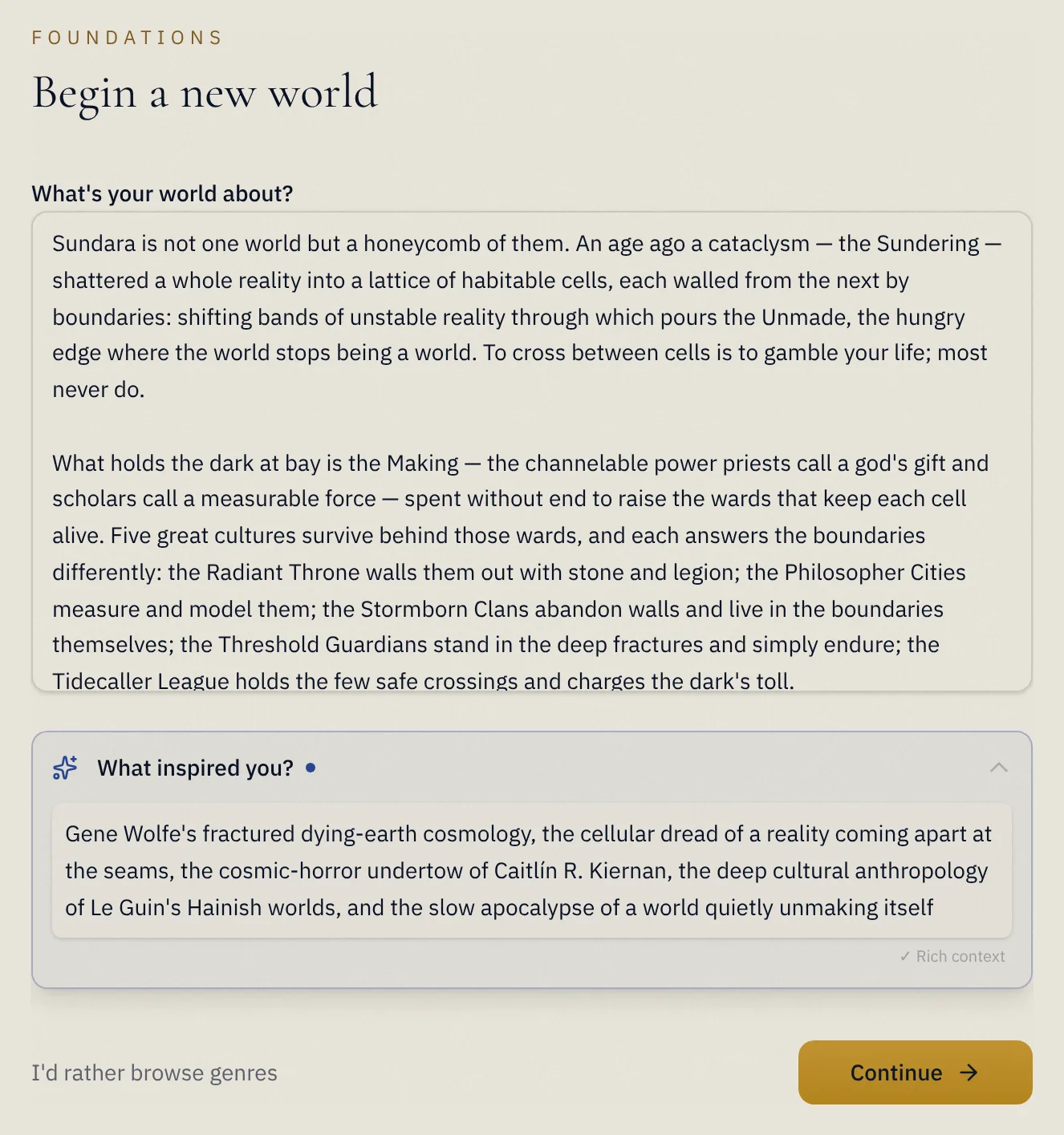
You describe the world

A paragraph, a mood, three films it should feel like. Not a form.

wizard · begin a new world
The seed step: a creator describes Sundara in their own words, with the books that inspired it.
Step 01 of 03
02

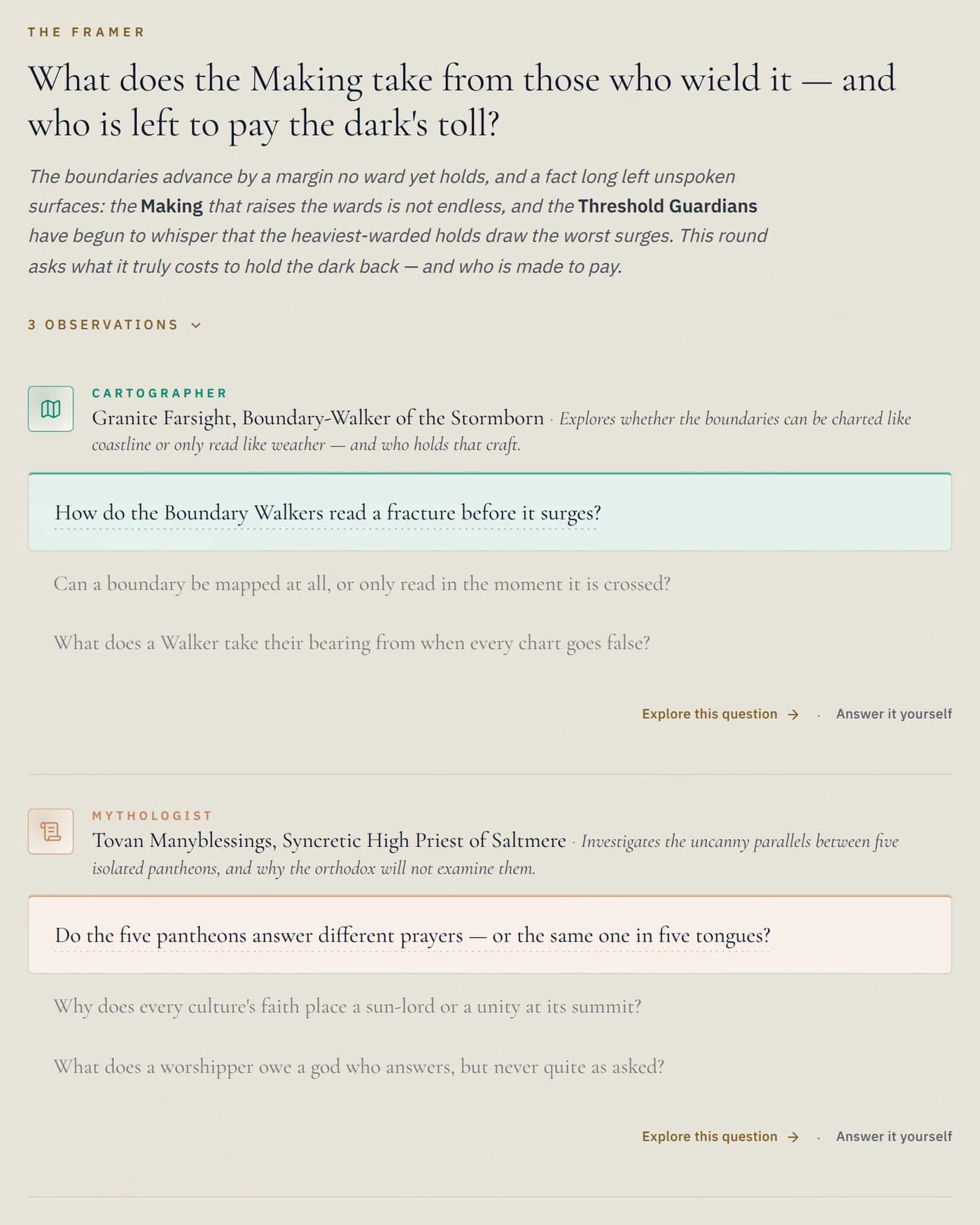
Nineteen specialists push back

Your Historian asks who wrote the history. Your Economist asks who pays for the war. Each comes back with three different answers, never one.

wizard · the framer
The round question, with a Cartographer and a Mythologist each pressing it from their own discipline.
Step 02 of 03
03

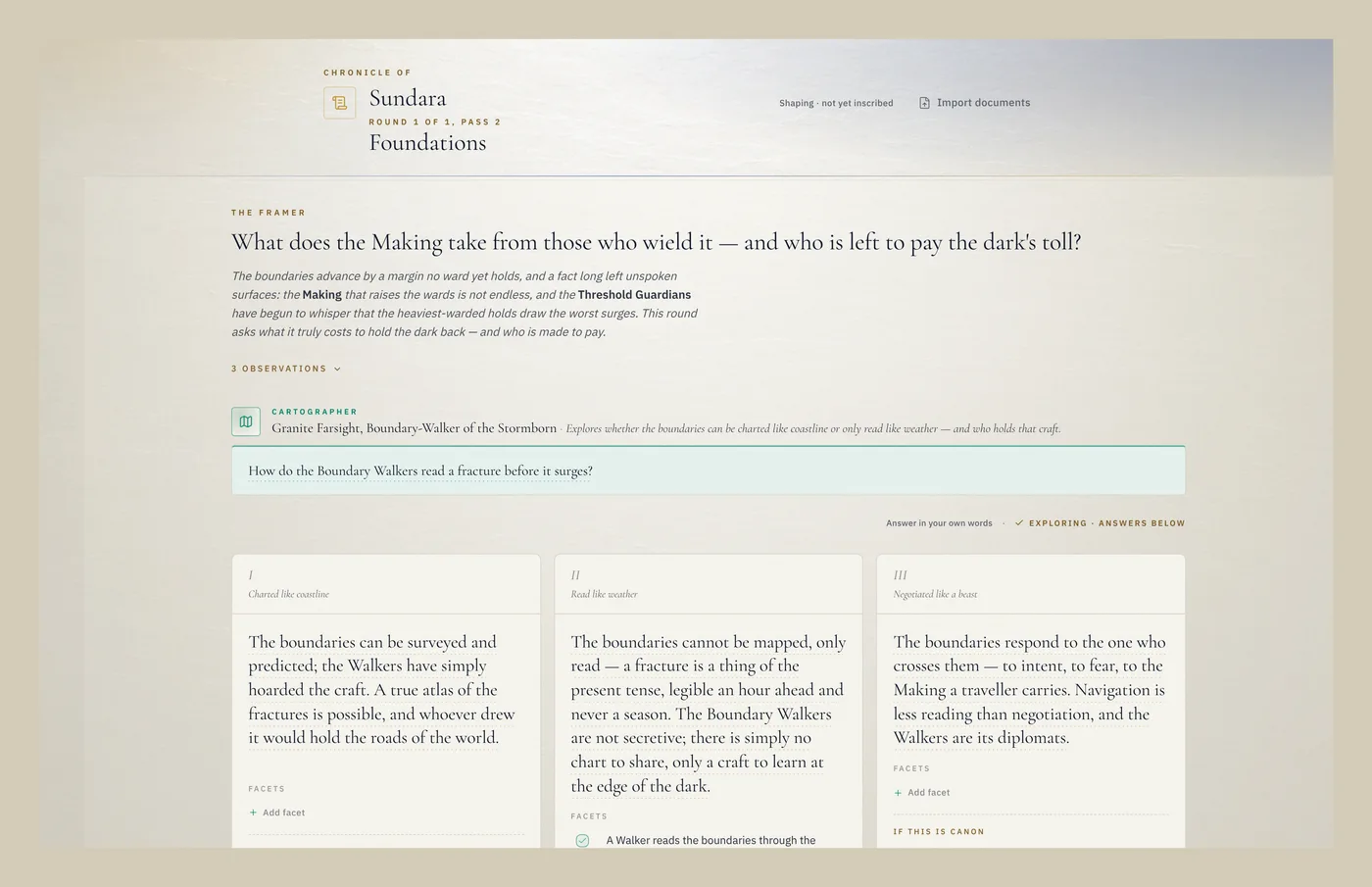
You decide the canon

Approve, refine, or take one deeper. Nothing is ever written into your world without you, and the ones you set aside are not wasted — they steer the next round.

wizard · answered in your words
The creator's own answer entered verbatim as canon, with the AI's three proposals left dimmed below it.
wizard · one round, end to end
  • Never without approval
    Accept, refine, or reject every proposal.
  • Never used elsewhere
    We never train on your lore.
  • Never optional
    The creator is central, not the model.
The standing council

Nineteen lenses, not one chatbot.

Each reasons inside its own discipline, asks its own questions, and knows which colleagues to pull in. Choose one.

The Historian

Events & TimelinesHistory · Time
Every war has two truths: the one the victors wrote, and the one the dead knew.
Voice

Measured and questioning; traces causality and consequence.

They might ask
What event do your people still argue about at tavern tables?
When this dynasty fell, who benefited most from the chaos?
Pairs withMythologistEconomistPolitical Scientist
19
domain specialists, each its own discipline

Your Guide orchestrates them, pulling the right specialist into the conversation when their expertise serves your vision, then weaving the threads back together.

Why it holds

A world that remembers itself.

Every place, person, and pact lives at a stable path in the codex, with its full revision history kept. Ask the Loremaster anything and it answers from your canon, citing the leaf each fact came from.

◆ Index · 87 leaves ◆ Search the codex
The Radiant Throne
The Sun Throne
The Scorched CrossingPrivileged
Powers of the Throne3
Powers & Pacts
The Covenant of Five Pillars
The Tidecaller Maritime CodeStale
The Veiled Archive
The Stormborn Clans8
Histories13
Figures & Relics
Lady Maren Solmarch
The Folded MirrorPrivileged
The Broken CircleSecret
The Philosopher Cities11
Lock glyphs guard what is private. Amber marks what has gone stale.
The Loremaster
Answers only from your canon
Who controls the safe crossings, and what do they charge?
The Tidecaller League holds the toll on every stable threadline crossing. Their rates climb during low fold, when safe passage grows scarce. The Cartographers' Guild disputes the toll but has never enforced against it.
1 /powers/tidecaller-league2 /concepts/fold-tides3 /orgs/cartographers-guild
Three leaves consulted. Every fact traceable. Nothing invented.
One page. Two audiences. You draw the line.

Those lock glyphs are not labels. Mark a passage privileged or secret and Canonry hides it from the readers who should not see it, without keeping a second copy.

What your audience sees

The Veiled Archive

The Veiled Archive keeps the oldest records of the Covenant: treaties, census rolls, and the warding-rites every culture swears to renew.

What you see

The Veiled Archive

The Veiled Archive keeps the oldest records of the Covenant: treaties, census rolls, and the warding-rites every culture swears to renew.

Privileged · hidden from your audience

The deepest vault holds the only proof that the Sundering can be turned back.

Secret · your note

Does the Tidecaller League already know what the vault holds?

Any genre, any tone

Fantasy is one shelf, not the library.

Cyberpunk gets clipped sentences and neon type. Cosmic horror gets long ones and cold light. Your genre changes what the council asks, which parts it deepens, and how the writing actually sounds.

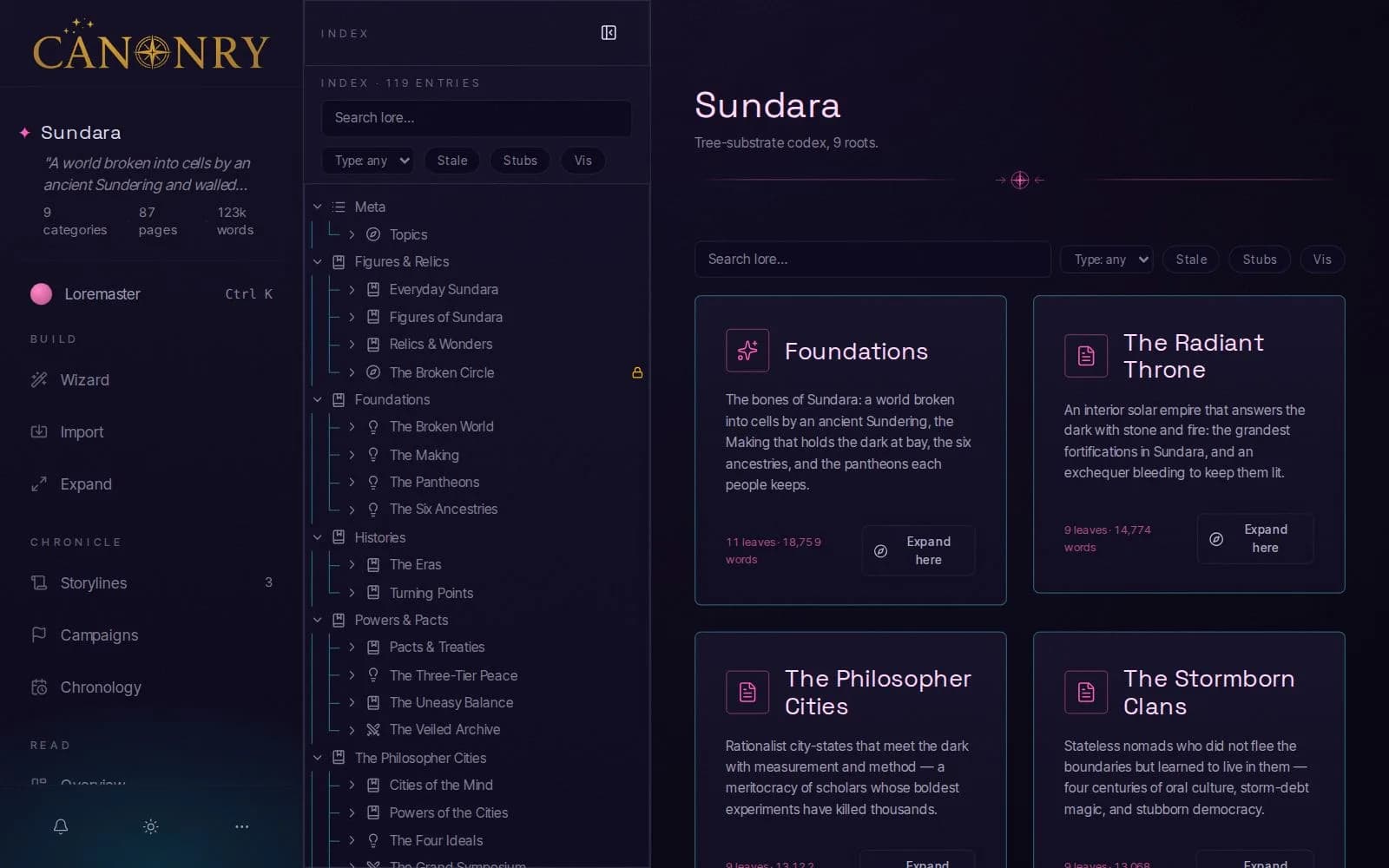
The Sundara codex under the Neon Meridian theme: vibrant, electric.
Cyberpunk · Urban Fantasy

Neon Meridian

Vibrant, electric

The neon cathedral sold salvation by the megawatt.

AaSet in Space Grotesk

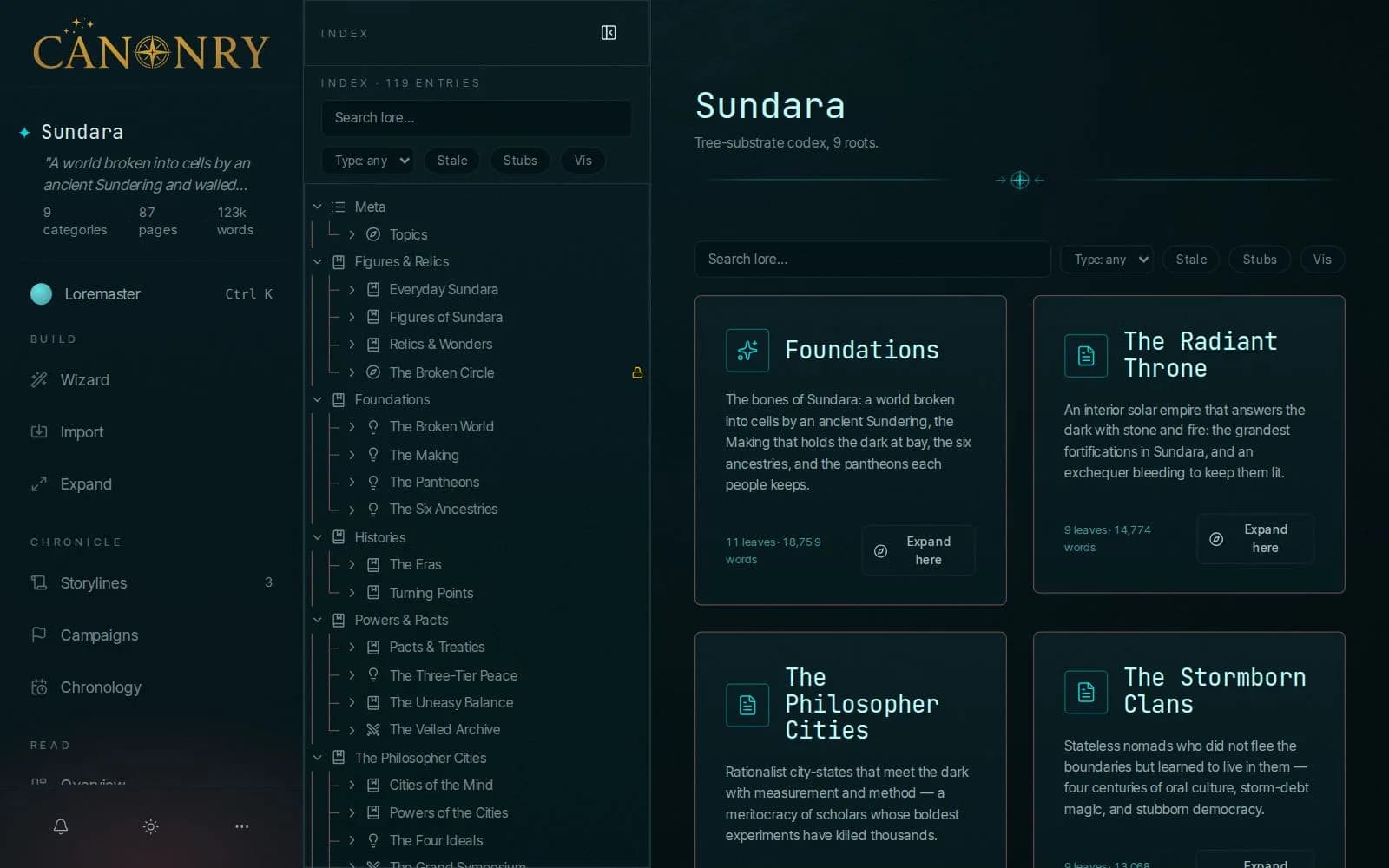
The Sundara codex under the Terminal theme: technical, precise.
Sci-Fi · Space Opera

Terminal

Technical, precise

Hull integrity nominal. The signal predates the station.
AaSet in JetBrains Mono
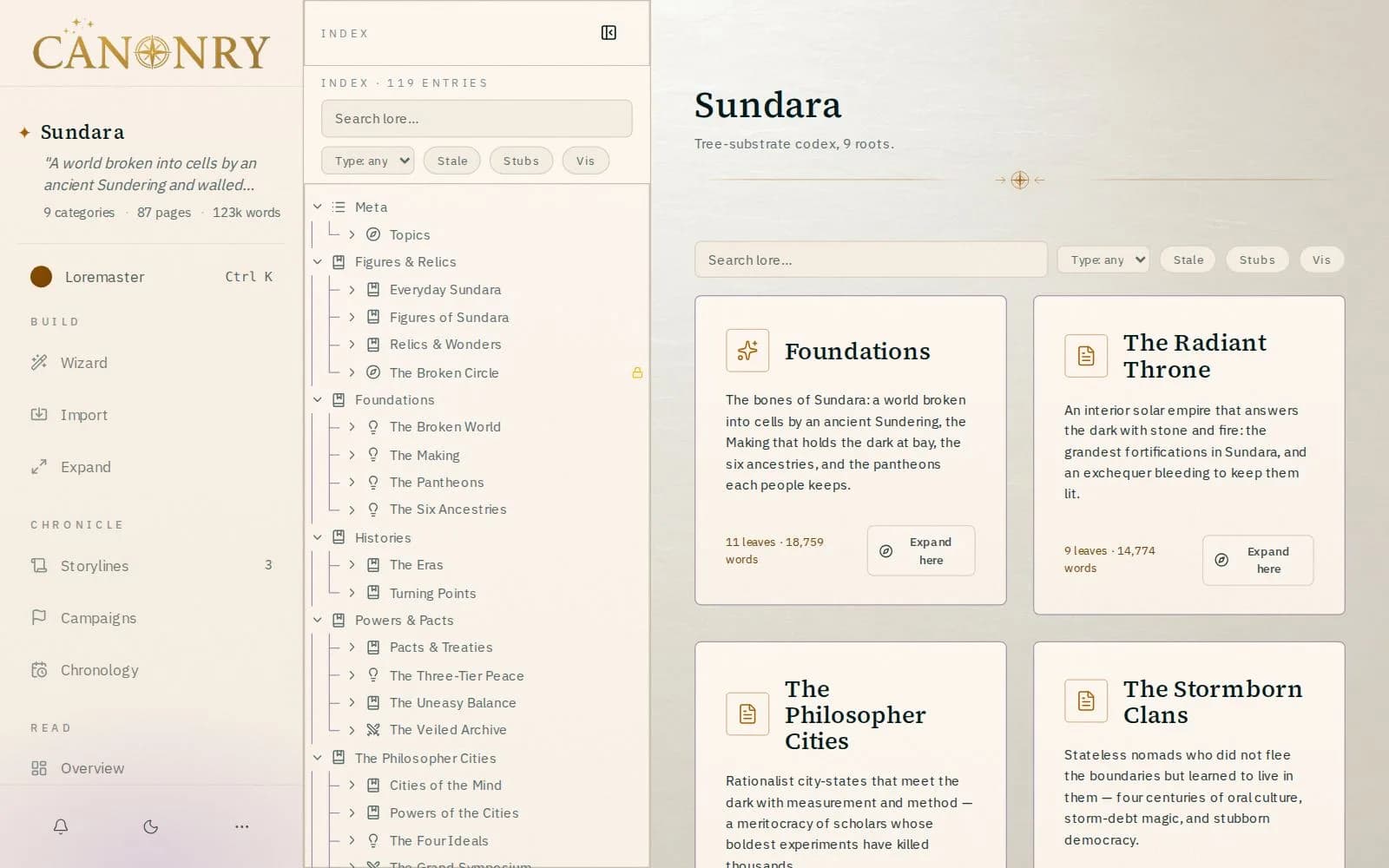
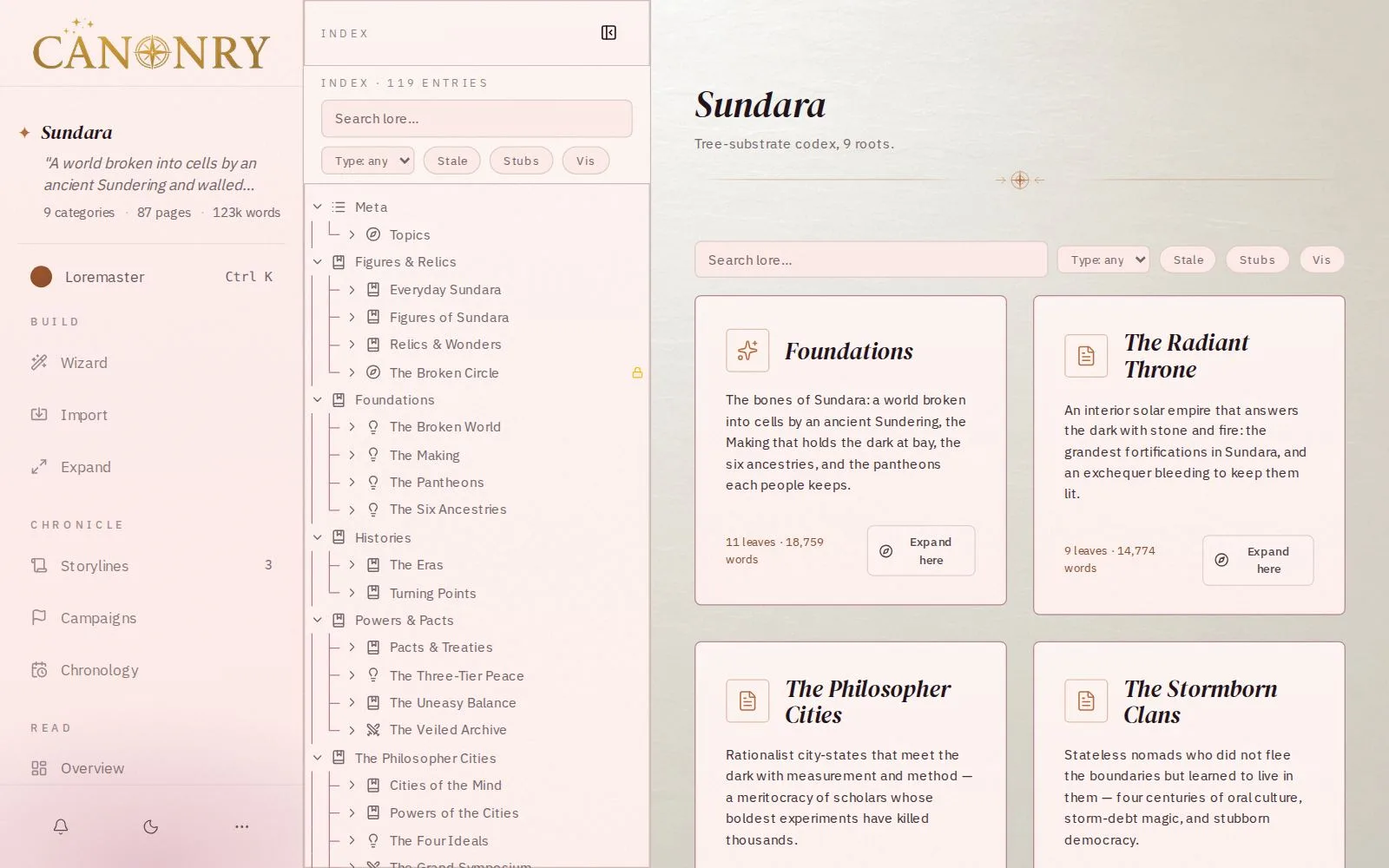
The Sundara codex under the Lamp & Letter theme: warm, contemplative.
Cozy Mystery · Literary

Lamp & Letter

Warm, contemplative

The parish kept better records than it kept secrets.
AaSet in Source Serif 4
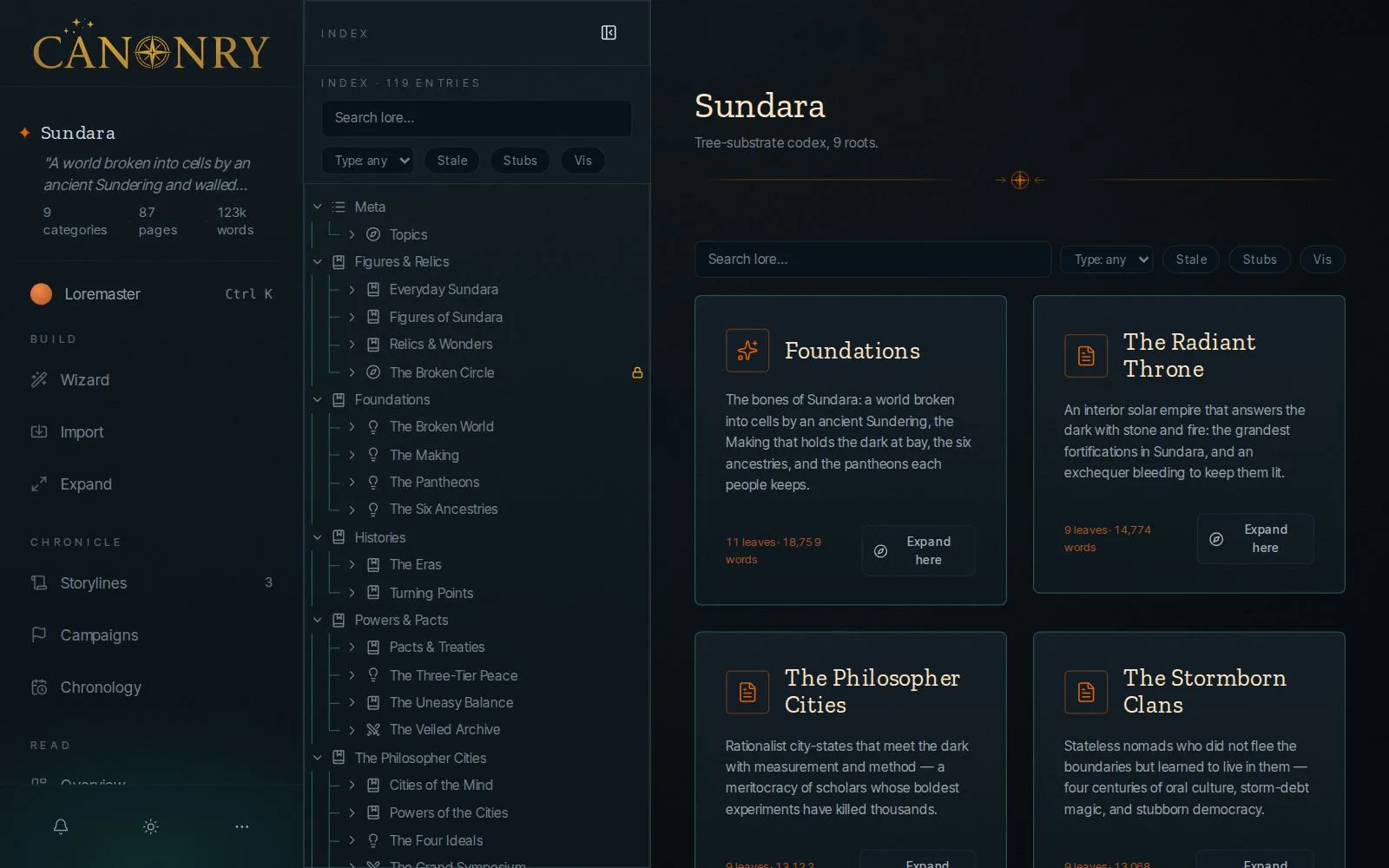
The Sundara codex under the Iron & Smoke theme: gritty, industrial.
Historical · Steampunk

Iron & Smoke

Gritty, industrial

The boiler-priests bled the furnaces to keep us warm.
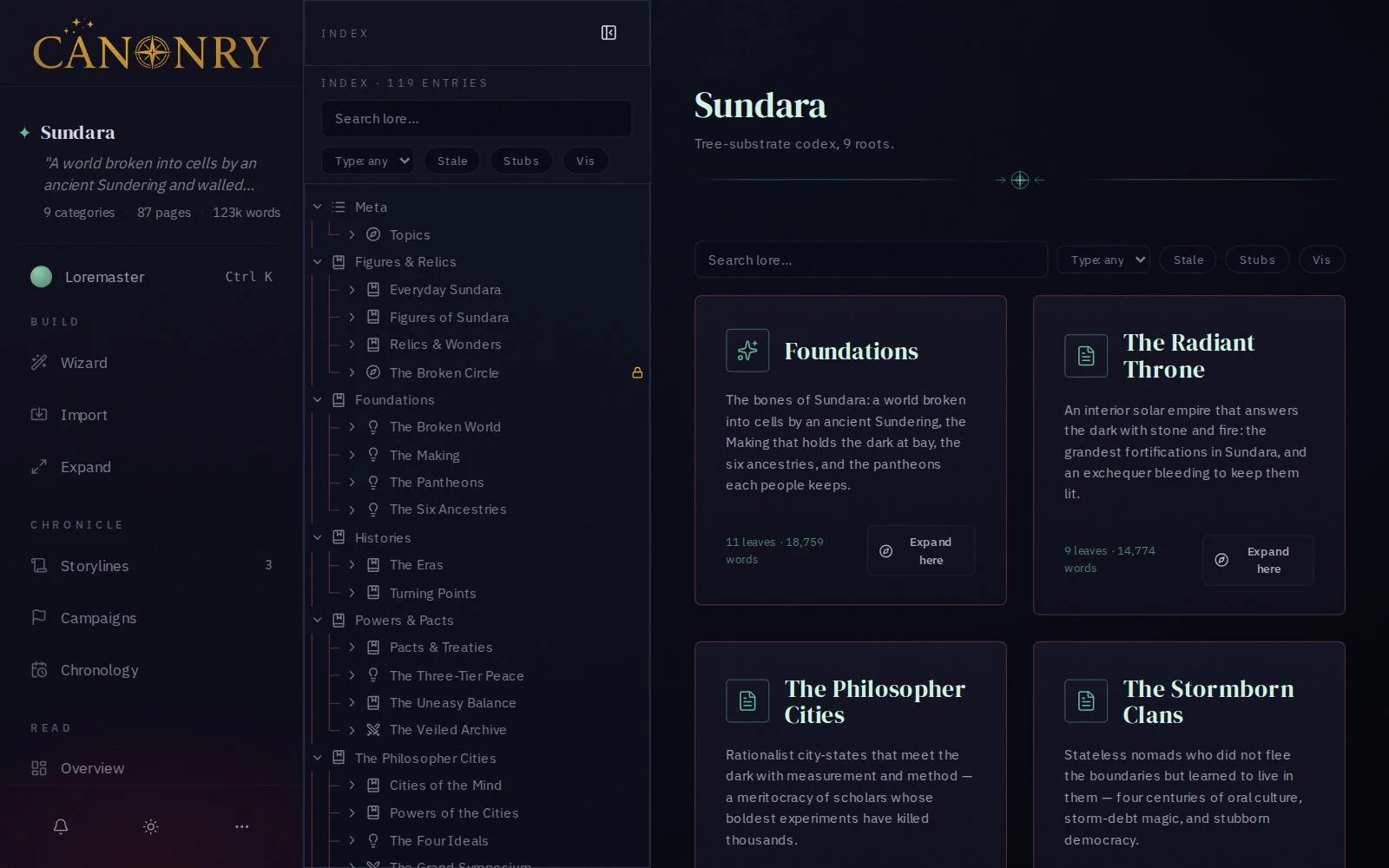
AaSet in Zilla Slab
The Sundara codex under the Deep Signal theme: eerie, cosmic.
Horror · Cosmic Horror

Deep Signal

Eerie, cosmic

Something beneath the ice is counting our heartbeats.
AaSet in DM Serif Display
The Sundara codex under the Hearts & Thrones theme: lush, courtly.
Romance · Political Drama

Hearts & Thrones

Lush, courtly

She wore the alliance like a gown, and meant to outlive it.

AaSet in DM Serif Display
6genres
50+sub-genres
13tones
17themes

Genre is not a coat of paint. It reorders the questions, the emphasis, and the voice, so a heist crew and a haunted abbey are never built the same way.

One thing before
you start.

Canonry asks for a creator who wants to be involved. If you want AI to do everything for you, this is not the right tool. That is the point.

Everything you build stays yours: export to Obsidian anytime, cancel anytime, nothing you don't approve ever enters your canon.

Free, one world, no card.